Why Your CS Resume Gets Ignored in 3 Seconds
Most CS intern and new grad resumes fail for the same reason. Here's what recruiters actually see when they open your PDF, and what you can do about it.
Recruiters who review intern applications at places like Google, Amazon, and Meta are looking at hundreds of resumes in a single sitting. Most get under 10 seconds before a decision is made. Yours probably isn't making the cut, and it's not because you're underqualified.
The real problem
A recruiter who reviewed 600 intern applications in two hiring cycles reported the same three projects appearing across most of them: a to-do list app, a generic e-commerce front end, a library management system. Technically correct. Completely forgettable.
The issue is not the projects themselves. The issue is how they are written. When your bullets describe what you built without explaining what happened, you give a recruiter nothing to hold onto.
Compare these:
Weak: Built an Android campus navigation app in Java.
Strong: Built a campus navigation app in Java, used by 200 students in the first 3 months, rated 4.7 stars on the Play Store.
Same project. Different signal entirely.
What recruiters are scanning for
When a recruiter opens your resume, they are quickly answering three questions:
- What did this person build or ship?
- Did it work? What was the result?
- Is any of this relevant to the role?
Most CS intern resumes answer question one. Very few answer question two. If your bullets only list responsibilities, you are describing a job description, not your work.
The fix is not complicated. Every bullet needs either a number, an outcome, or a scope indicator. If you genuinely do not have metrics, estimate conservatively. Recruiters understand that student projects do not come with analytics dashboards.
| Instead of this | Write this |
|---|---|
| Developed REST API for internal tooling | Built REST API reducing data retrieval time by 40%, used across 3 internal teams |
| Worked on ML model for image classification | Trained ResNet-50 classifier reaching 94.2% accuracy on a 50K image dataset |
| Built e-commerce front end with React | Shipped React storefront with sub-1.2s load times handling 500+ concurrent users |
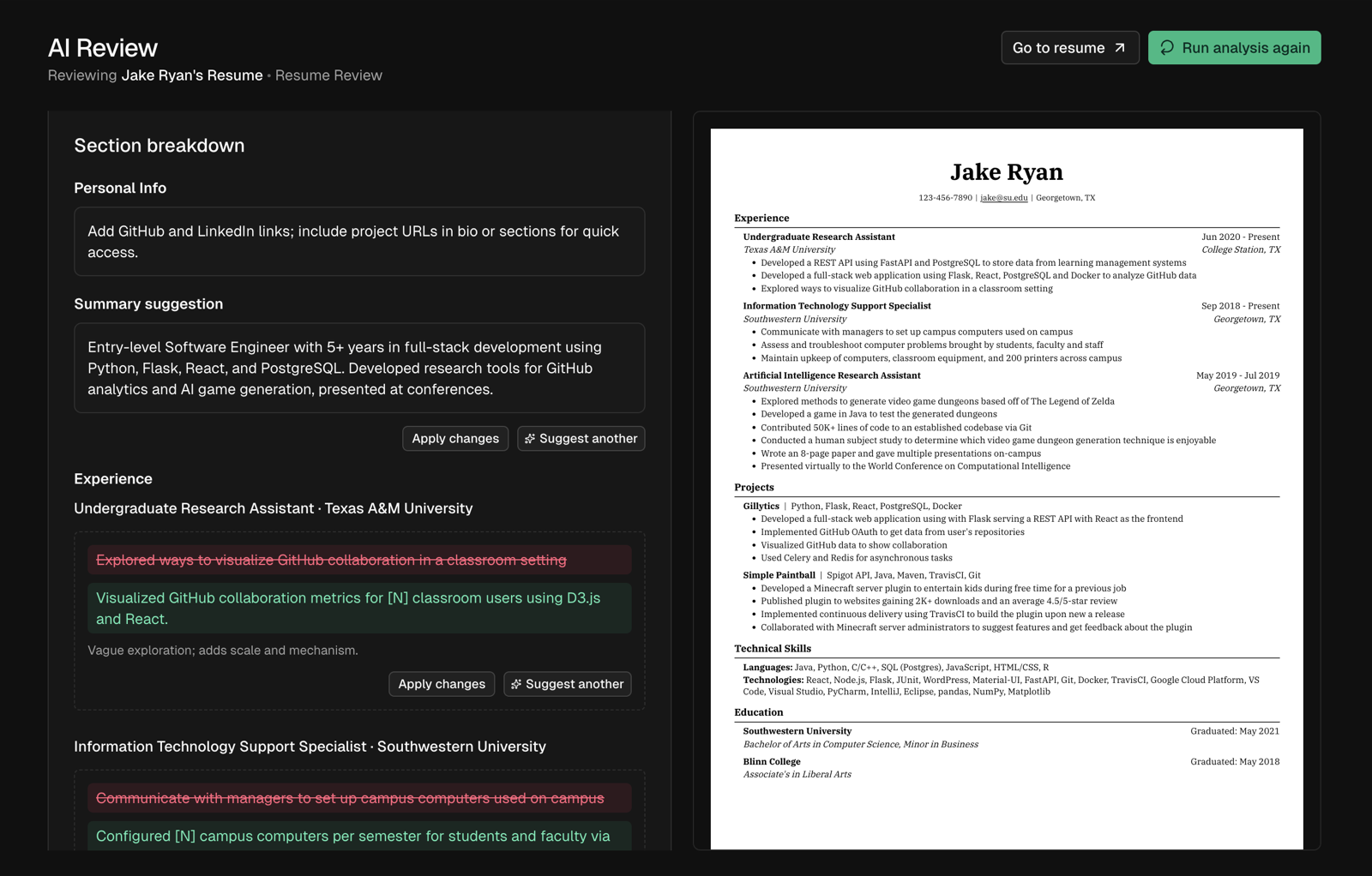 HiredUp's AI Review workflow, where users get section-level resume feedback and apply stronger bullet suggestions.
The ATS myth burning your time
Most CS students spend hours gaming ATS scores. Here is what is actually true: most ATS systems do not auto-reject resumes. They organize and surface them for a human to review. The bot is not the final decision maker.
Keyword-stuffing to hit a 72% match score does not get you interviews. Analysis of recruiting outcomes found resumes with more than five buzzwords see a 12% drop in interview rate. The tools selling you a low ATS score are, in many cases, designed to show you that number so you upgrade to their paid plan.
What actually gets you past the screen:
- Relevant job title keywords woven into your experience bullets, not dumped into a skills section
- Clean formatting with no tables inside tables, no text boxes, no multi-column layouts that break PDF parsing
- Standard section headers: Work Experience, Education, Skills. Not "My Journey" or "What I've Shipped"
Why submitting the same resume everywhere does not work
Sending identical resumes to 200 companies is the fastest path to 200 non-responses. Every job description is a direct list of what a specific hiring manager wants. When your resume does not reflect their language and priorities, they move on, not because you cannot do the job, but because nothing in your resume tells them you can do their job.
Tailoring manually takes 30 to 45 minutes per application. Almost nobody actually does it. The candidates landing interviews are either applying to fewer roles with carefully tailored resumes, or using tooling that handles the matching automatically so they can apply at volume without the quality drop.
What a strong CS intern resume actually looks like
These are the consistent differences between resumes that get callbacks and ones that do not:
One page. You have limited experience. Use the space you have well, do not pad it.
Projects over coursework. A deployed side project with 50 real users outweighs most academic credentials in tech recruiting conversations.
An active GitHub. If the link is on your resume, make sure the repos are not empty. Recruiters at FAANG companies check.
Stack specificity. Listing Python, Node.js, and PostgreSQL with real project context is stronger than a 20-tool skills dump. Only list what you could comfortably be asked about in an interview.
Impact-first bullets. Lead with the result. "Reduced API latency by 35% by migrating from REST to GraphQL" is stronger than "Used GraphQL to improve API performance."
A tailored summary. Two sentences. Who you are, what you are looking for, one line that mirrors the role you are applying to. Takes 60 seconds. Most people skip it.
What most AI resume tools get wrong
Most tools rewrite your bullets to sound polished and keyword-rich. The output reads exactly like every other AI-generated resume in the pile. Recruiters are already trained to spot and discount this pattern.
What works is a tool that reads the actual job description you are applying for, surfaces which keywords matter for that specific role, and helps you rework your own experience using your real background. Not fabricated bullets. Not keyword soup dressed up as impact.
That is what HiredUp does. Paste in a job posting, connect your existing resume, and get a tailored version that sounds like you wrote it, because you did.
Learn more about how ATS systems actually work and why keyword stuffing backfires. Then use the simple playbook to landing your first tech job to turn a stronger resume into interviews and offers. Explore more job search resources to improve your employment prospects.
More from the resource library
Build your resume, tailor each application, and track your progress in one place.